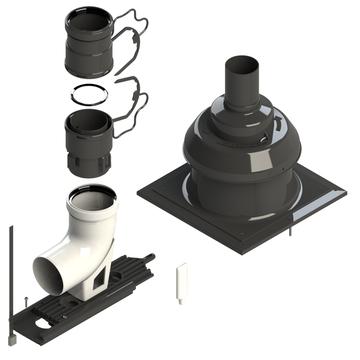
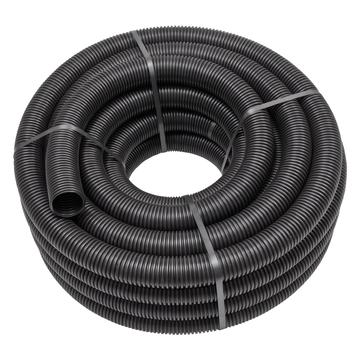
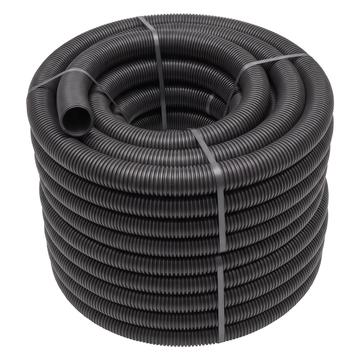
With C15 in a shunt each boiler gets its own PPs flexible liner ø60 or ø80 to above the roof, and the shunt stays the shared air supply. A multikap with one terminal per boiler goes on top.
Read more
Enter the number of appliances and the height above to see which parts each boiler needs.
How C15 works in a shunt
Each dwelling gets its own flue: a black, UV-resistant PPs flexible liner from the boiler to above the roof. There is no flue gas connection between dwellings any more. The air enters at the top of the shunt, flows down the main duct and through the shunt opening into the branch duct, and so reaches the concentric connection of each boiler.
At the bottom of the branch duct sits a support bend 87°. The liner rises from there, crosses through the shunt opening into the main duct at the top of the floor and continues up to the roof. The liners are pulled in from the top down.
The requirements for C15
| Requirement | What it means |
|---|---|
| Fan | Fan-assisted appliances only. Natural draught is not allowed. |
| Air section | The free space around the liners is at least 1.5 times the sum of their inner sections. |
| Terminal | Always vertical, through the multikap. |
| Shaft | Airtight: old connections, hatches and penetrations closed, no other pipes or cables. |
| Outside | Plastic that comes outside is UV-resistant. |
| Boiler | Approved as C(15) according to gas.be (NBN D 51-003 annex E). |
A main duct of 20 x 20 cm takes two ø80 liners. Three ø80 need a main duct of 20 x 35 cm. More fit in ø60, if the calculation with the boiler data allows it.
How to build your list, from top to bottom
- Multikap: stainless steel with 2 to 6 connections or ALU with 1 to 5. For a single boiler a mounting kit is enough.
- One black UV terminal per boiler.
- One 25 cm black UV pipe per boiler.
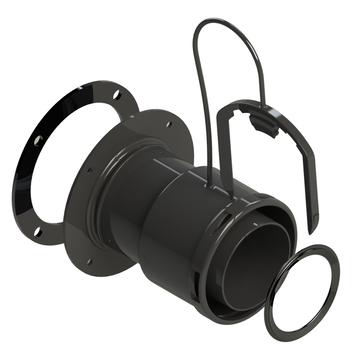
- One connection socket with flange per boiler.
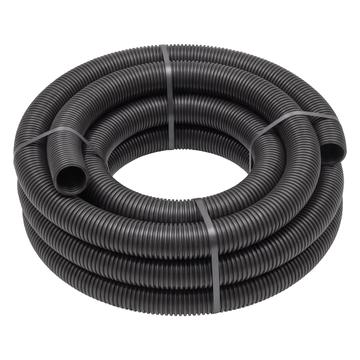
- Flexible liner on a roll (12.5, 25 or 50 m). Choose the rolls so each boiler has one length without a joint.
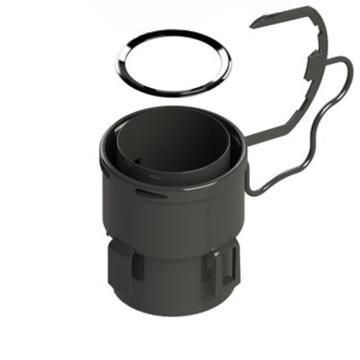
- One bottom coupling per boiler.
- One support bend 87° per boiler in the branch duct.
- Optionally per boiler a concentric pipe with finishing plate or rosette.
Frequently asked questions
When do I choose C15 instead of C14/C13?
When few boilers are on the shunt and each dwelling wants its own flue. Also when the boilers are not approved for a collective flue under positive pressure, but are approved as C(15).
What diameter does the liner have?
ø60 or ø80. It follows from a calculation to EN 13384 with the boiler data, the height and the bends.
Can a dwelling fit a different boiler later?
Yes, on its own liner, if the new boiler is approved as C(15) and has the same connection.
How does the liner go into the shaft?
From the top down, with a pull rope. The support bend at the bottom carries the weight.