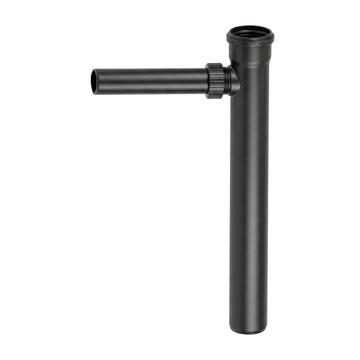
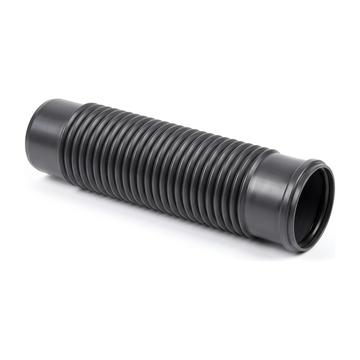
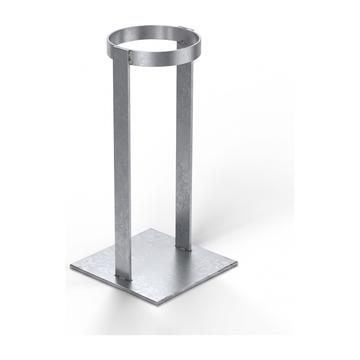
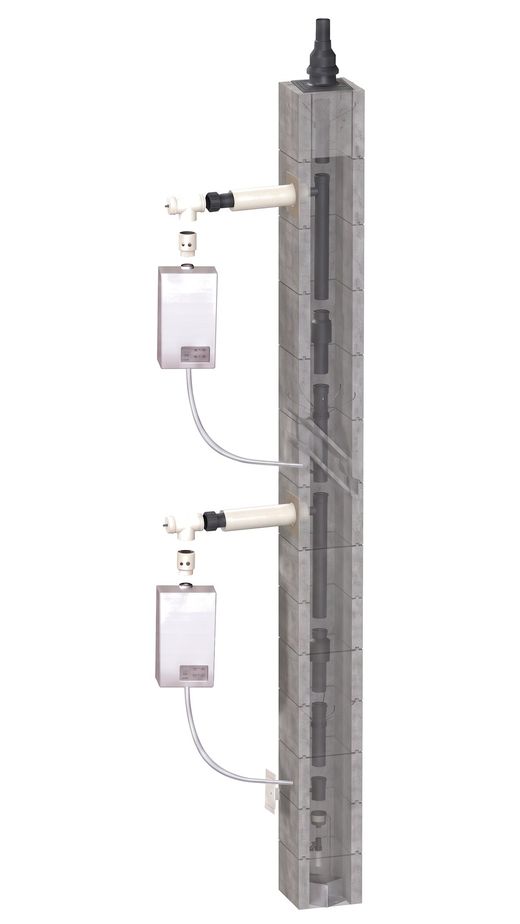
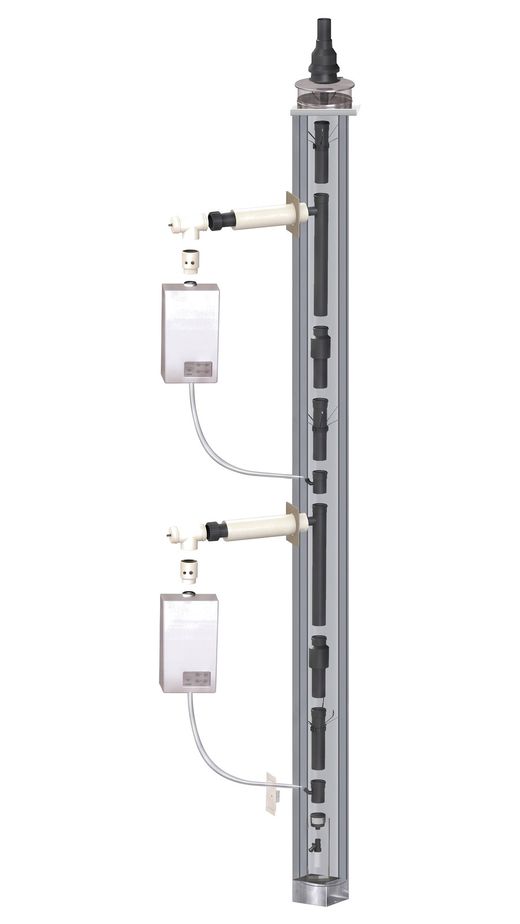
Collective renovation C14 Star: a rigid black PP liner (PZ series) for a common flue in an existing shaft, from ø110 to ø200 with ø60 or ø80 branches. Condensing boilers on several floors discharge into one column; the combustion air is taken from the shaft around the liner (C14, semi-CLV). Each tee has a screw-on connection pipe: the column is lowered into the shaft from the top and one ø130 mm core hole through the shaft wall per boiler is enough. An absorber below each tee takes up the expansion. Flue gas up to 120 °C, positive pressure, EN 14471.
Read more
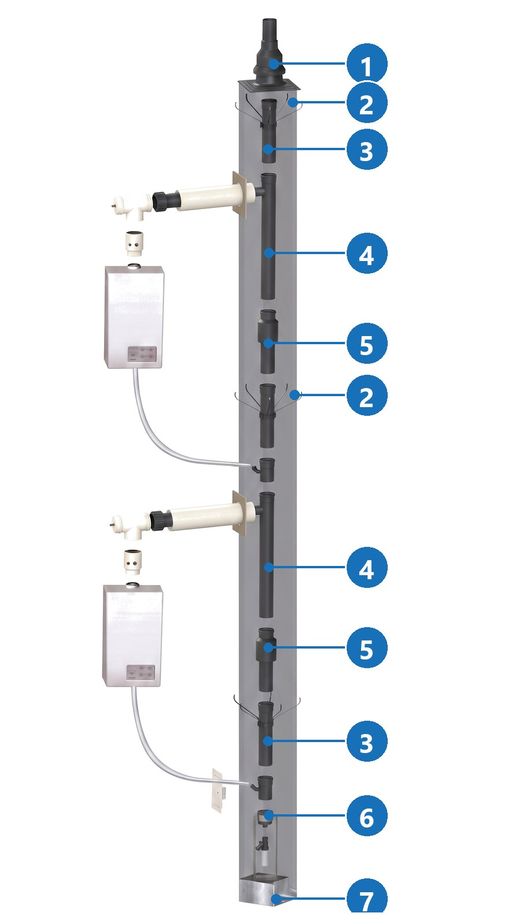
Build-up from top to bottom. The numbers also appear in the image. Repeat 2 to 5 for every floor with a boiler.
| No | Part | Code | Where |
|---|---|---|---|
| 1 | Terminal with shaft cover plate, black UV-resistant | PZK | at the top of the shaft; the combustion air also enters the shaft here |
| 2 | Spacer | PZAH | every 2 m, keeps the column centred in the shaft |
| 3 | Black PP pipe 25 cm, 50 cm, 1 m or 2 m | PZ25, PZ50, PZ100, PZ200 | between the tees, combined to length |
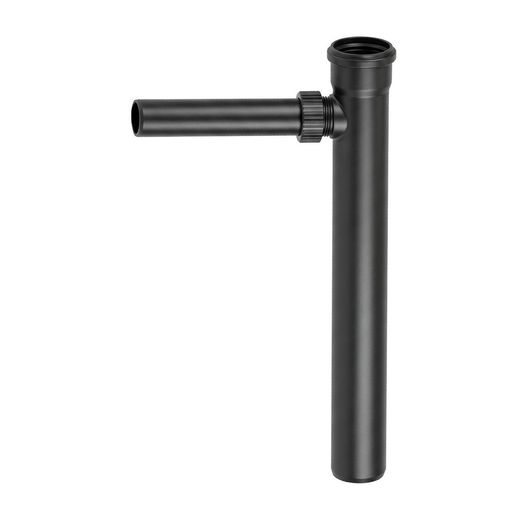
| 4 | C14 tee 87° 1 m with screw-on connection pipe | PZC14T | one per boiler, socket up, at the height of the ø130 hole |
| 5 | Absorber 500 mm | PZC14ABS | directly below each tee |
| 6 | Socket with condensate drain | PZRBK | at the foot of the column, in the ring of the ground support |
| 7 | Ground support | PZC14SV | on the floor of the shaft, carries the column |
| – | Concentric boiler connection with wall plate | per boiler | inside the flue gas to the connection pipe, outside the air from the shaft |
| – | Siphon rated for positive pressure | separate | below the socket with drain, to the sewer or a neutralisation box |
One ø130 mm hole per boiler, no large openings. An ordinary tee does not fit down a shaft because of its branch: the shaft then has to be opened on every floor. The branch of the C14 tee has a screw coupling. Lower the column from the top without the connection pipes, drill one ø130 mm hole through the shaft wall on each floor (in a shunt simply through the shunt into the main channel) and screw the 500 mm connection pipe onto the branch through that hole. The concentric boiler connection fits in the same hole. The screw connection stays tight under positive pressure, does not work loose from expansion or vibration and can be undone later for inspection: sturdier and more durable than a click connection. The socket always points up, the tee as high as possible below the ceiling.
Why an absorber below each tee? A rigid PP pipe expands when it heats up, about 0.16 mm per metre per degree: more than 4 cm over a 3 m storey. The tees are held in the wall by their connection pipe, so the pipe between them cannot slide freely. The 500 mm absorber takes up that expansion, so tees and socket joints are not put under stress.
How does the air reach the boiler? In C14 the existing shaft is the air duct. The combustion air enters at the top along the shaft cover and flows down around the column, while the flue gas rises inside the column (counterflow). Each boiler connects concentrically to the shaft wall with a wall plate: inside, the flue gas goes through the ø60 or ø80 connection pipe to the tee; the outer pipe ends open in the shaft and draws the air from there. The shaft must therefore be airtight: all other openings, hatches and penetrations closed, no other pipes in the shaft. The connection slopes at least 3° towards the boiler, and every boiler has backflow protection (in the boiler or with a flap). Only use boilers approved for a collective flue under positive pressure, C(10) or C(14), according to gas.be (NBN D 51-003 annex E).
In a shunt or an old CLV. In a shunt chimney the column goes into the main channel. The shunt partition may be drilled so the secondary channels also supply air; the old connections of the dwellings are closed, all appliances are replaced together and the ventilation of the dwellings is arranged separately. An old CLV (3CE) consists of two concentric tubes in a masonry casing: the old flue in the centre, the air jacket around it. The column goes into the old flue, which stays in place as a sleeve. As before, the air enters through the existing CLV cap with mesh and flows down the air jacket; the concentric boiler connection ends open in that jacket, only the connection pipe passes through the wall of the old flue into the tee. If the old flue is not straight, choose PR C14 Flexible.
Condensate. At the bottom, the socket with drain collects the condensate of the whole column; drain it through a siphon rated for positive pressure and, for larger outputs, through a neutralisation box.
Which diameter? The column diameter follows from the number of boilers, their output, the height and the shaft size (EN 13384-2). Send us the boilers, the number of floors and the shaft size: we check the flue and draw up the parts list.
Star or Flexible? If the shaft is straight and wide enough, PZ C14 Star gives a sturdy column with fixed tees. If the shaft has bends or offsets, choose PR C14 Flexible.
Ventichim supplies the complete collective C14 flue, from roof terminal to ground support, to installers throughout Belgium. The C14 parts are not in stock: delivery time 2 to 3 weeks.