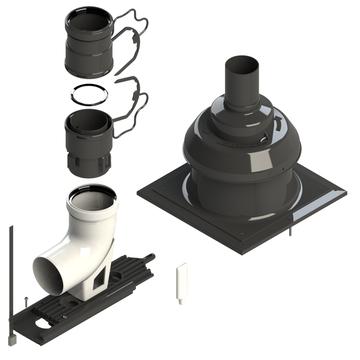
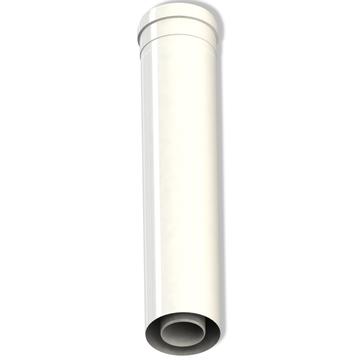
A shunt or an old CLV is renovated with a new liner in the existing shaft: one common flue (C14/C13) or a separate flexible liner per appliance (C15). Choose below whether it is a shunt chimney or an old CLV.
Read more
In a collective chimney of an apartment building, the shaft stays in place. You pull a new flue into it and the space around it becomes the air supply for the boilers. This way you replace the boilers in a building without building a new chimney.
Shunt or old CLV
A shunt chimney is a concrete duct from the 1960s and 1970s. Each floor has a branch duct that joins the main duct one floor higher. An old CLV (3CE, LAS) consists of two concentric stainless steel pipes in a masonry casing: flue gas in the centre, air around it. In a CLV renovation the old inner pipe stays in place as a casing for the new liner, and the outer jacket remains the air supply.
C14/C13 or C15
| C14/C13 | C15 | |
|---|---|---|
| Flue | One common flue for all appliances | A flexible liner ø60 or ø80 per appliance |
| Air supply | C14: through the shaft, counterflow. C13: separate per appliance | Through the shaft, shared by all appliances |
| Pressure | Positive pressure, backflow protection per boiler | Fan-assisted appliances only |
| Per appliance | A tee in the flue | A liner from the boiler to above the roof |
| At the top | One terminal | Multikap with one terminal per appliance |
| Boiler | Approved as C(10) or C(14) | Approved as C(15) |
| Flue gas between dwellings | One shared flue | No connection left |
| Suits | Many appliances, little room in the shaft | Few appliances per shaft, a separate flue per dwelling |
If the shaft has little clearance and many boilers are connected, one pipe (C14/C13) usually works better. For two or three dwellings that each want their own flue, C15 is the simplest route. A shunt of 20 x 20 cm takes two ø80 liners at most.
How to build your list
- Check which shaft is in place: shunt chimney or old CLV.
- Measure the shaft: the main duct of the shunt, or the diameter of the old inner pipe.
- Count the appliances and floors, and note the boiler connection (80/125 or 60/100).
- Choose C14/C13 or C15 and open the category.
- Enter the number of appliances and the height in the list builder. You get the parts from top to bottom.
- Put everything in your cart or ask for a quote.
Frequently asked questions
Which boilers can go on a renovated chimney?
For C14/C13, only boilers approved for a collective flue under positive pressure, C(10) or C(14). For C15, boilers approved as C(15). You find them on the gas.be list (NBN D 51-003 annex E).
Which diameter do I need?
It follows from a calculation to EN 13384-2, with the number of boilers, their output, the height and the shaft size. Send us the boiler data and the shaft size and we will check it.
Does the shaft have to be airtight?
Yes. The shaft is the air supply, so all hatches, old connections and penetrations are closed and no other pipes or cables run through it.
Does Ventichim install the renovation?
No. Ventichim is a wholesaler and supplies the material to installers. The installer does the installation.